Who can add funds to a trust?
Setting up
a trust
A Trust looks after money for a person or a group of people.
is a fantastic way to provide for a loved one with a
learning disability
A learning disability is to do with the way someone's brain works. It makes it harder for someone to learn, understand or do things.
or
autism
 Autism is a disability. Autistic people find it difficult to understand what other people think and feel. They also find it difficult to tell people what they think and feel. Everyone with autism is different.
. Once you've done that, and updated your will to include a gift to the trust, you can be confident that Mencap Trust Company will be there to help your loved one after your death. So what next?
Go to sections:
Telling people about your trust
While setting up a trust can be a deeply personal thing, it is worth considering whether other people – for example, close family – might also be exploring how best to provide for your loved one. Knowing that you've set up this trust, and that they can make a gift to the trust in their will (or in their lifetime), might save them the cost of putting separate arrangements in place.

Even more importantly, if they aren't aware that it’s possible to put a trust in place – or why it can be beneficial – they might make an outright gift to your loved one, creating the very problems you put this trust in place to guard against.
If another family member or friend wants to make a gift to your trust, they can use the details we gave you for your own will. If they want to make a lifetime gift, we’re happy to talk to them about that – but we would need your permission first.
Finally, if you have friends or family who are themselves caring for someone with a learning disability, please consider telling them about Mencap Trust Company and the service A service gives people what they need, like healthcare services that help people when they are ill, and support services that give people support. we offer.
Who can make a gift to the trust?
Anyone who isn't a beneficiary of a trust can give money to the trust. By "beneficiary" here we mean both the loved one who is the main beneficiary of the trust, and also the people you have nominated to receive any funds remaining in the trust when your loved one has died.
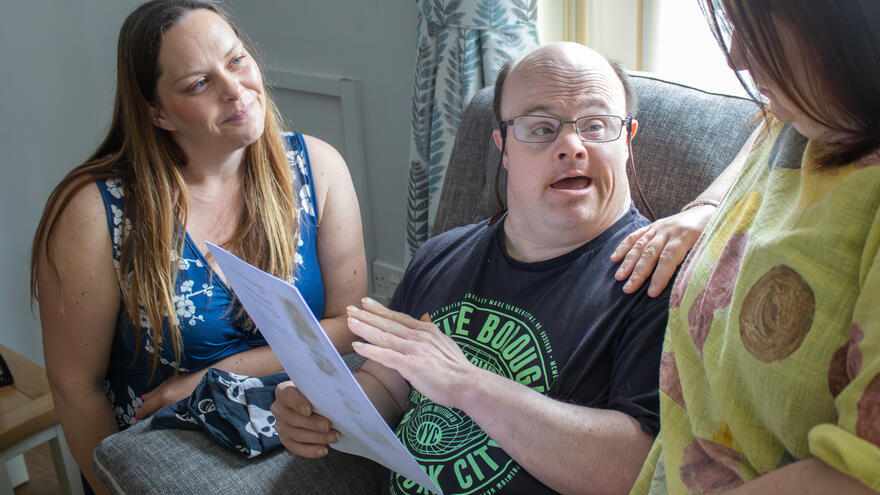
Consider making a lifetime gift to the trust
Many of the families we work with choose to give money to the trust while they’re still alive, rather than leaving it until they’ve died. There are many reasons why some people do this but the most common are below.
Avoiding probate delays.
Dealing with an estate can be time consuming; when we receive a gift through a will, it can be several months – or even a year or more – before the executors are able to pay the money to us. That can mean the funds are locked away where they can’t be used to support your loved one. Setting aside some money ahead of time means we can start supporting your loved one straight away.
Inheritance
tax
 Tax is the money that pays for things like schools, hospitals and the police. There are different types of taxes like income tax, VAT and council tax.
planning.
Lifetime giving can be a powerful tool for reducing your inheritance tax – ultimately meaning more money goes to support your loved one, rather than being paid to HMRC. Each person has a tax-free allowance they can give away without paying inheritance tax on it – in the 2026-27 tax year this is £3,000. Larger gifts are exempt from inheritance tax as long as you survive by 7 years. (Care is needed if you’re thinking of paying more than the nil rate band – which in 2026-27 is £325,000 - into a discretionary Discretionary means it is up to somebody to decide if you get something. trust, as that can trigger an immediate inheritance tax bill. See “converting to a disabled person’s trust” below if that might be relevant to you.)
Seeing the trust in action.
We believe that Mencap Trust Company offers a fantastic and distinctive service for people with a learning disability or autism. We also know that many of the families we support appreciate seeing how this works in practice, and giving their loved one a chance to get to know the people who will be supporting them when those who set up the trust are no longer around. A lifetime gift enables us to do that.
If you'd like to discuss how to add money to the trust during your lifetime, whether in a lump sum or instalments, please get in touch.
Like all professional trustees, we have a minimum amount that we will accept into a trust. That’s because our charges are based on the value in the trust, and – while we keep our charges as low as we can – they do have to cover the cost of delivering the service.
The minimum amount that needs to be paid into a trust before we can actively start supporting your loved one as at April 2026 is £20,000.
Making changes to the trust
If your circumstances or those of your beneficiaries change, you might decide you need to make changes to the trust.
Some changes are just a matter of updating our records – for example, because a beneficiary has moved house, or changed their name. For changes like this, we just ask that you let us know. Sometimes we might ask for evidence – for example, a copy of the marriage certificate showing the change of name.
Other changes might be more significant, requiring a new deed.
If you want to discuss a potential change to your deed, please contact us.
Changing to a Disabled Person's Trust
One change we’re often asked about is when someone has set up a discretionary trust, and has now been advised they should have a disabled person’s trust instead.
To help identify which type of trust could be the most suitable, understand the differences between a discretionary and a disabled person's trust first.
Converting to a disabled person's trust
One reason legal advisors are increasingly recommending disabled person’s trusts is the “residence nil rate band.” This is an additional inheritance tax relief introduced for those leaving their homes to children or other descendants, which was brought in by the government The Government are the people who run the country. They decide how much tax people should pay for things and how things like the National Health Service should work. in 2017. The relief isn’t automatically available if the home goes to a discretionary trust; whereas it is available if a home (or the proceeds of selling a home) goes to a disabled person’s trust set up for the benefit of a descendant.
It’s worth saying that you don’t have to convert your trust to a disabled person’s trust during your lifetime for the residence nil rate band to be claimed. It’s normally still possible to get the relief by taking action within two years after you’ve died, and we do work closely with executors to see if that’s possible and appropriate in each case. Because of this, some families choose to take a “wait and see” approach – for instance, in case the inheritance tax rules or other circumstances change so that a disabled person’s trust is no longer beneficial by the date of your death.
However, if you want to change the trust to a disabled person’s trust, just let us know. There are eligibility criteria for a disabled person’s trust; you can read an outline of what these are here, but you should speak to your own solicitor for detailed advice. Subject to confirming those criteria are met, we can normally convert your existing trust to a disabled person’s trust.
Please note we charge a one-off fee of £95 +
VAT
 VAT is also called Value Added Tax. VAT is the extra money you pay when you buy things. The money goes to the government to pay for things like schools and hospitals.
to cover the work
involved
Involved is being included in something or taking part in something.
.
Where to get help
We are not authorised to give advice, but we can answer questions about how our trusts could work. If you’re working with a legal professional or financial Financial means anything that is to do with money. It is used to describe how people, businesses, or governments get money and how they use it advisor, we’re also very happy to talk things through with them directly.
We would always recommend you seek professional advice before taking any of the actions we’ve mentioned above. If you haven’t already got an advisor to support you, we would recommend you use the STEP member directory to find one who is qualified in this area.